How To Make A Good Book-to-Movie Adaptation
This article was provided to The Film Magazine for exclusive use by Beth Sawdon of flipendofilms.
Some of the greatest films of all time started their lives as scripts, ideas on a mind-map, a bullet point in a coffee-stained notebook. But, some films were born in novels. Novels written on train journeys bit by bit, or even slaved at for weeks at a typewriter. These books and stories we hold dear have been adapted for our visual pleasure onto the big screen, though it remains common knowledge that some adaptations are more successful than others.
Why is that? Surely a book-to-film adaptation simply involves reading the source material and recreating what’s on paper?
Ha! If it were that easy, the 1991 adaptation of Stephen King’s IT wouldn’t have been the utter sham that it was.
There is much more to our favourite adaptations than meets the eye, so I have taken it upon myself to compile a list of factors to consider when creating a book-to-film adaptation that we can collectively acknowledge as being good, or at least as good as a literary adaptation can be in the relatively short medium of film.
1. Honour the Source Material
The original work is the main source of information when recreating an already successful novel into a film. It is essential that the narrative of an adaptation follows the original work as closely as possible, yet isn’t drawn out too much. With this in mind, it is important to consider the best route of recreation – is it possible to work it into one film, or will it be a series?
The Lord of the Rings series was split into three films, just like the books, and to great critical and commercial success. The following story of The Hobbit was also split into three films despite being inspired by a singular novel, and was done so to a more mixed reception. Some may consider this a money-making tactic, but the length and depth of Tolkien’s novel arguably required a detailed trilogy.
Regardless of the number of films needed to re-imagine a novel, the key events must be included for the film to ring true to the book. The plot must flow as smoothly as that in the book does in order for the adaptation to be a success. Descriptions of settings, characters and events must also be correctly interpreted and brought to life to appeal to both the book and film audiences – this is particularly important with fantasy novels, where readers have spent time imagining the worlds and characters described to them on paper. Harry Potter and the Philosopher’s Stone perfectly recreated the scene in which the first years arrive at Hogwarts, for example. Prior to the 2001 film’s release, fans had been making their own minds up for four years on how Hogwarts would look, and how it would feel to see it in real life. The movie didn’t disappoint, birthing a memorable and powerful moment for fans if not cinema as a whole.
2. Work With the Author (If Possible)
Once the original work has been read, it is vital to think about and work with the author. After all, they created the story and should therefore at least be a part of it’s adaptation. In fact, many authors may have already considered a film adaptation following the success of the book!
When it comes to casting, direction, design and other varying aspects of film production, the author being at the heart of it all can be a huge asset; assisting in the transformation of their ideas and offering tidbits of inspiration or knowledge that may otherwise be missing.
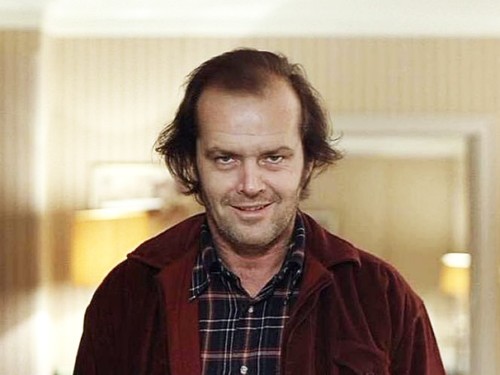
After becoming engrossed in The Shining, Stanley Kubrick approached Stephen King with his mind already full of visualisations for his impressive novel. Before landing on Jack Nicholson to play the lead role, King disapproved of Kubrick’s other choices of Robert De Niro, Robin Williams and Harrison Ford. Without Stephen King’s input, we could have had funnyman Robin Williams shouting “here’s Johnny!” through a crack in a door; an image I’m sure you won’t soon forget!
Although the film was a great success, King still wasn’t satisfied with Kubrick’s choice however, as in the novel, Jack Torrance slowly becomes more and more paranoid, detached and unhinged; whereas King believed that Nicholson’s portrayal was borderline psychotic from the start. Although it is important to please and entertain an audience with a film adaptation, it is vital to listen to the author when making their dream a reality, for even in the case of a great adaptation like The Shining, there remains a missing link and the feeling of unlocked potential that could have brought about something altogether greater.